














Custom labels & stickers for businesses worldwide
Home / Resources / BOPP vs Vinyl Labels
Resources · Comparison guide

BOPP vs Vinyl Labels

Compare the material you are actually buying, then consider the adhesive and finish as part of the same construction.

Updated · A practical starting point; confirm details for your application.

A label is a combination of layersIllustration showing optional protective finish, printed film face stock, adhesive and release liner as separate layers.Finish · face stock · adhesive · linerEach layer can change the result.

Illustration for guidance; not a photograph or production proof.

On this page

The quick answer

BOPP is biaxially oriented polypropylene. “Vinyl” usually refers to PVC, but names used in a catalogue may vary: ask for the actual polymer and grade before comparing. Neither name alone guarantees a label’s resistance, flexibility, removability or service life.

Identify the material

A trade name is a starting point

BOPP is a film made from polypropylene and oriented in two directions during manufacture. Vinyl is commonly used to describe PVC film, but a product name alone does not establish the exact polymer, formulation or intended use.

For a meaningful comparison, request the actual polymer, material grade and thickness in µm for each option. Then compare the samples under the same application and exposure conditions.

Differences within a material family can be substantial. Ask for a data sheet when it is available, and confirm which construction the stated data applies to.

When a listing says “vinyl”

Ask whether the face stock is PVC or another polymer. If it is not identified, treat the comparison as incomplete until the supplier confirms it.

A closer look

Vinyl in a sticker-making example

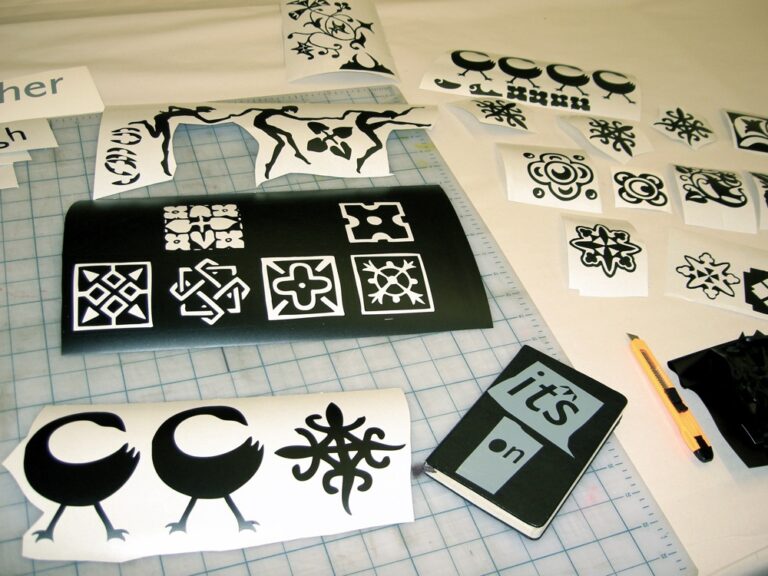
This example shows vinyl designs on backing during sticker making. Material grade, adhesive and finish still need to be specified and tested for the intended application.

Black vinyl sticker designs on a cutting mat and worktable
Third-party illustrative example. Photo by Britta Gustafson, CC BY-SA 2.0; image resized for display.
Compare the families

Use the job to narrow the options

Biaxially oriented polypropylene

BOPP

Often considered for packaging labels where film appearance and resistance to moisture are useful. White, clear or metallised presentations may be available depending on the grade.

  • Check conformability against the container curve and squeeze.
  • Match adhesive to the surface, application temperature and use.
  • Test print and finish against the intended exposure.
Explore BOPP
Confirm the actual polymer

Vinyl

Often used for stickers where a flexible film is desired. PVC grades can differ in thickness, formulation and behaviour, so ask for the material data and a representative sample.

  • Check the material on the exact curve or textured surface.
  • Confirm the adhesive and any protective laminate.
  • Discuss outdoor, UV or chemical exposure with the supplier.
Explore Vinyl
The full construction

The face stock is only one layer

Adhesive

Adhesion depends on the adhesive, surface, cleanliness and temperature at application. Removability must be tested on the intended surface.

Ink and protection

Ink system and a suitable finish can affect abrasion, moisture, UV and chemical resistance. An untested laminate is not a performance guarantee.

Thickness and flexibility

Record face-stock thickness in µm and check the entire construction on curves or squeezable containers. Thicker does not automatically mean better for every job.

Test on the real surface

Apply representative samples to the actual container or surface. Let the bond develop as advised, then test the temperatures, contents and handling the label will encounter.

Make a useful comparison

Questions to send with your project

  • What are the actual polymer, grade and face-stock thickness in µm?
  • Which adhesive and liner are included? Is the adhesive intended to be permanent or removable on my surface?
  • Is the film white, clear or another finish? Is a laminate or varnish included?
  • What is the surface material and shape, and at what temperature will the label be applied?
  • Which moisture, abrasion, oils, chemicals, UV or temperature conditions should be tested?
  • Can representative samples and the relevant technical data be supplied for the proposed construction?

Share the conditions with your project contact and request the comparison in your quotation.

Ready to Start Your Next Project?

Tell us what you need. We will help you work through the specification and quotation.

SamplesRequest a Quote